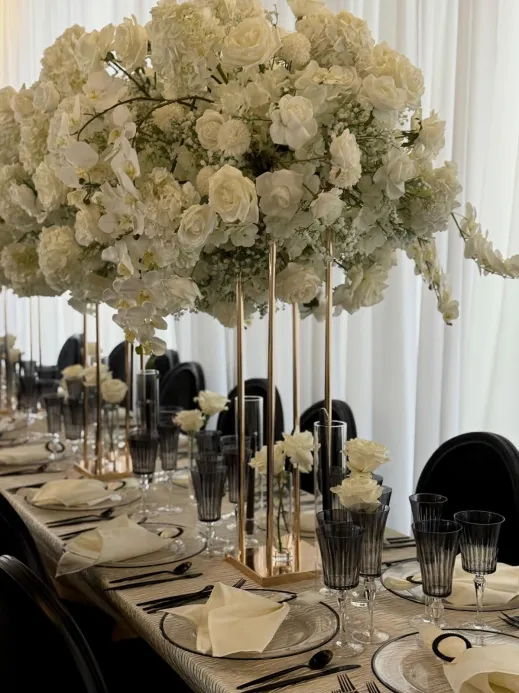
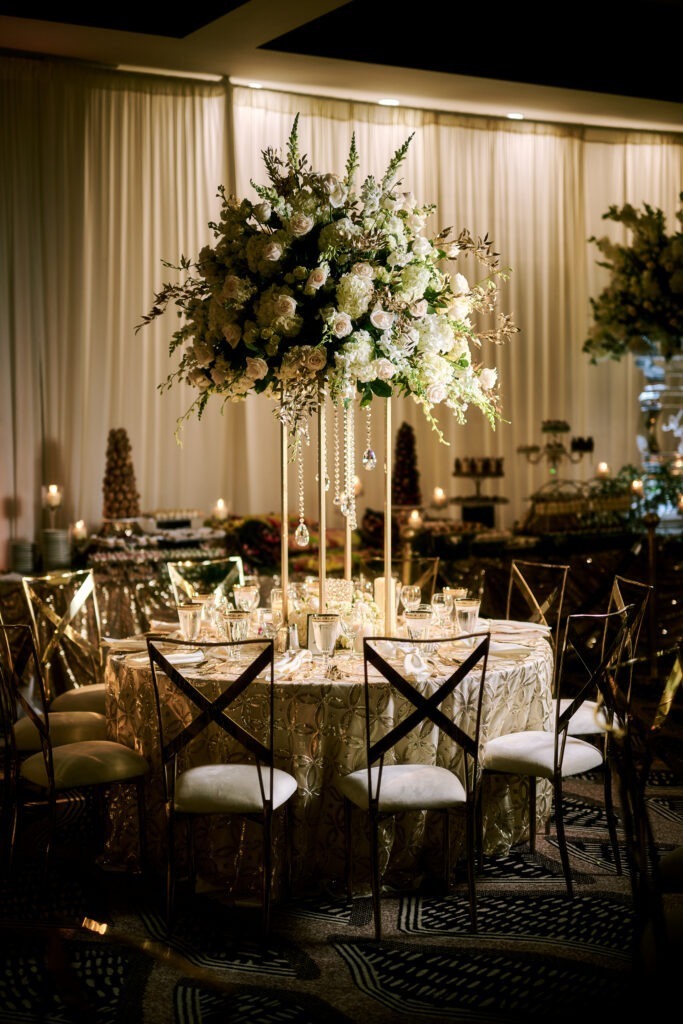
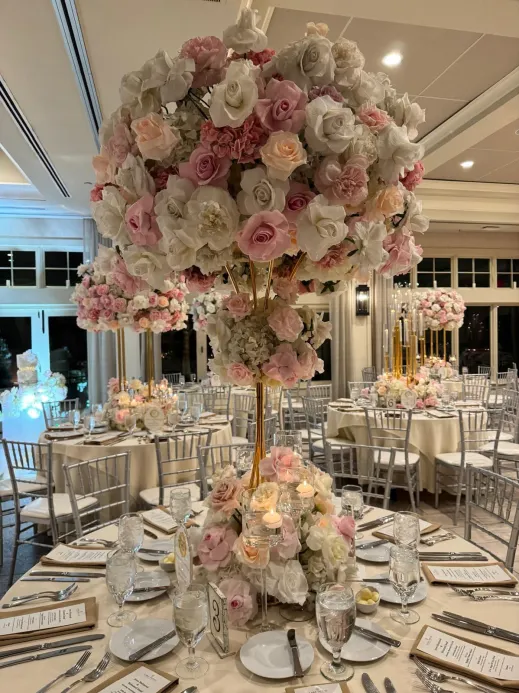
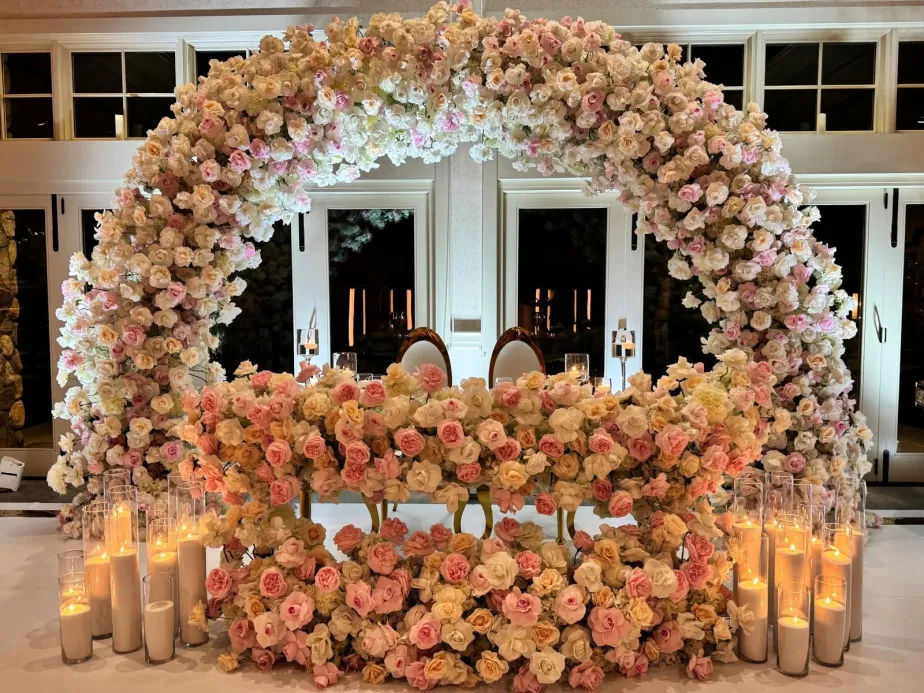
A hanging garden suspended above a dance floor at The Bowery Hotel. A 14-foot living wall behind the head table at a Tribeca loft wedding. A wisteria-dripped trellis framing the entrance to a rooftop reception in Chelsea. These are the projects that keep our designers up late sketching and showing up early to build. Large-scale floral installations sit at the intersection of art, architecture, and engineering – and our Midtown studio has been producing them for NYC weddings and events for over ten years.
Here’s the thing about installations that most couples don’t think about when they screenshot that gorgeous hanging arrangement on Instagram. Somebody had to figure out how to attach 200 pounds of flowers to a ceiling that may or may not have structural support points in the right locations. Somebody tested whether the rigging hardware could hold the weight after six hours of gravity pulling moisture out of the stems, making the whole thing heavier as water drips down. Somebody calculated the clearance needed so the tallest guest at the reception doesn’t crack their head on a dangling orchid during the first dance.
That somebody is us. Has been for years. And we take the engineering side of installation work just as seriously as the creative side. A breathtaking floral cloud means nothing if it sways when the AC kicks on or sheds petals into people’s wine glasses all night.
Anything structural. Anything that goes beyond placing an arrangement on a flat surface. Suspended pieces hanging from ceiling beams or rigging points. Flower walls built on freestanding frames. Climbing arrangements that wrap columns or spiral up staircase banisters. Overhead garland canopies that run the length of a dinner table. Archways so dense with blooms you can smell them from twenty feet away.
Some are massive statement pieces that become the defining visual of the entire wedding. Others are smaller and more targeted – a lush frame around a doorway, a floral moment cascading over a balcony railing, a single dramatic branch arrangement suspended above the sweetheart table. Scale varies. The level of planning and structural attention does not.
Half the battle with suspended installations in Manhattan happens before we touch a single flower. It happens on the phone with the venue’s facilities manager asking about ceiling load capacity, beam locations, and whether they allow rigging hardware to be attached to their structure.
Some venues – The Foundry in Long Island City used to be a favorite example – have exposed steel beams that are basically begging for hanging florals. Others have decorative plaster ceilings from 1920 that can’t support anything heavier than a paper lantern. We’ve run into both situations in the same month. At spaces with structural limitations, we bring freestanding truss systems that create overhead attachment points without touching the ceiling at all. Heavier. More setup time. But the visual result is the same and the venue coordinator isn’t having a heart attack about damage deposits.
The flower wall trend has been going strong in NYC for years and honestly shows no signs of slowing down. What has changed is the level of sophistication couples expect. Nobody’s impressed by a flat grid of carnation heads glued to a foam board anymore. The walls we build have depth, dimension, and variety – blooms at different stages of openness, mixed greenery textures, unexpected elements like dried grasses or seed pods breaking up the pattern.
We construct walls on modular frames in our studio and transport them in sections for on-site assembly. Standard sizing runs between 8 by 8 feet and 10 by 12 feet, but custom dimensions are normal for us. Last spring we built a curved flower wall that followed the arc of a mezzanine railing at a Flatiron District venue. Required custom frame fabrication and about twice the build time of a flat wall. Looked absolutely unreal in the photos. That’s the kind of project that makes the extra work feel worth it.
Every suspended installation gets planned around verified ceiling specs and load capacity. We test hardware at our studio before it ever arrives at your venue.
Large installations require assembly at the venue. Our crew arrives with the structural components, the pre-conditioned florals, and a build plan timed around your venue’s load-in schedule.
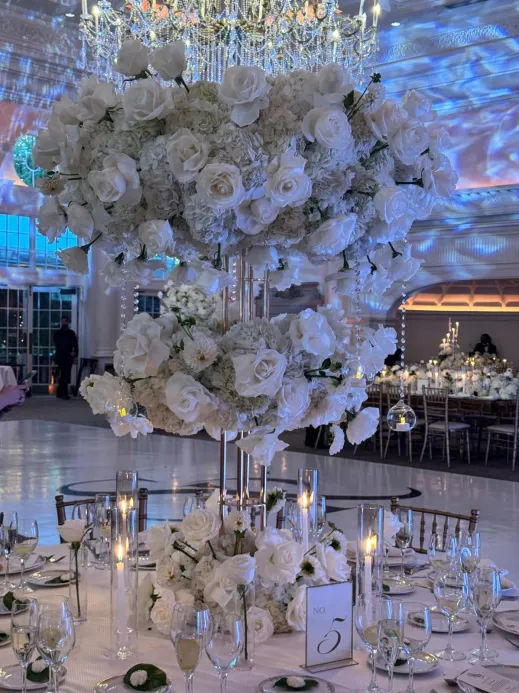
This is probably the most requested installation type at NYC weddings right now. A cloud of flowers floating above the spot where you’ll have your first dance. Visually stunning. Photographically incredible when the DJ hits the right lighting. Logistically more complicated than it looks.
Weight distribution is the first concern. An unbalanced hanging piece will tilt to one side and look crooked from every angle in the room. We build a structural grid – usually steel or aluminum – and distribute the floral weight evenly across multiple attachment points. Stem length, water source, and drip management are the next concerns. Nobody wants to slow dance in a light rain of flower water. We use water tubes on individual stems and seal the grid’s underside to prevent moisture from reaching the guests below.
One more practical note. The dance floor needs to be clear of obstructions at head height. If your installation hangs at eight feet and your tallest groomsman is six-five, that clearance matters. We confirm height restrictions with your venue and your planner before finalizing the design height.
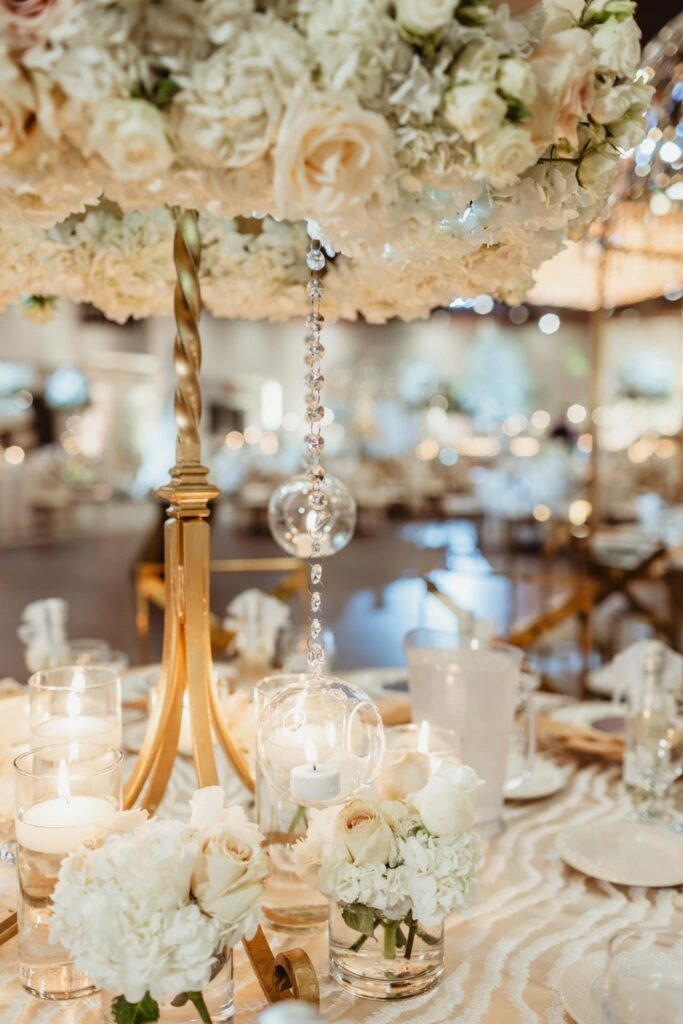
Venues with prominent staircases or interior columns offer a natural canvas for climbing floral work. A garland winding up a banister railing. Bloom clusters anchored to columns at staggered heights. Greenery spiraling up a pillar from floor to ceiling with a few focal flowers tucked in at intervals.
This kind of installation reads as effortless and organic. Actually executing it requires precise anchoring – most venue coordinators will not let you hammer nails into a marble column, shockingly enough – and a solid understanding of how gravity and time will affect the arrangement over the course of the evening. Garlands sag. Stems that were perky at 4 PM get droopy by 9 PM if the variety isn’t right. We select hardy climbers and structural greenery for these pieces and use cable ties, monofilament, and removable adhesive hooks depending on the surface material.
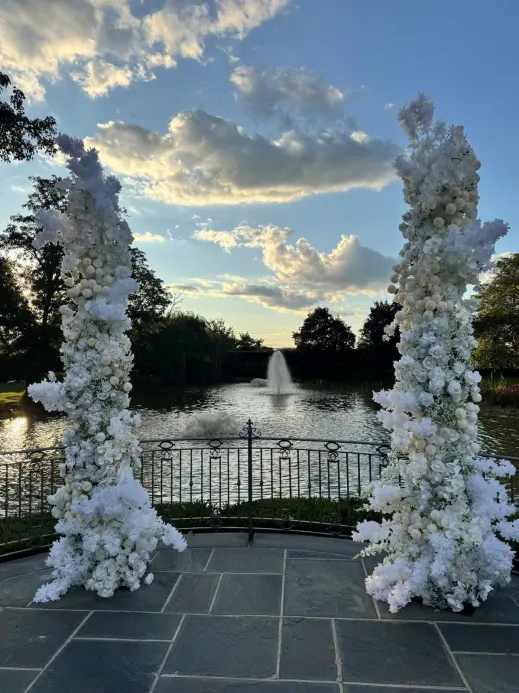
Outdoor weddings in this city come with a built-in layer of risk. Wind. Rain. Sun exposure. Temperature swings from afternoon to evening. Indoor installations deal with climate control and stable conditions. Outdoor pieces deal with actual weather – and that weather changes its mind constantly between May and October.
A garden trellis covered in blooms at a Brooklyn backyard wedding needs to survive a potential afternoon breeze that picks up around 3 PM near the waterfront. A suspended arrangement at a rooftop venue in Hudson Yards can’t swing freely when gusts come through. We use weighted bases, guy-wire stabilization, and wind-resistant bloom varieties for every outdoor installation. If the forecast looks genuinely threatening, we have a contingency conversation with your planner about what can be moved indoors and what stays outside with added reinforcement.
Longer than most couples expect. A simple hanging arrangement – single focal piece, moderate size, venue has accessible rigging points – might take two to three hours including hardware setup, floral placement, and final adjustments. A large flower wall with on-site assembly runs three to five hours depending on size and complexity. A full overhead canopy spanning a 40-foot dinner table with multiple attachment points and hundreds of stems? That’s an early-morning start and a multi-person crew working through the afternoon.
We build setup time into the master event timeline well before the wedding week. Venue access windows vary wildly in NYC. Some give us the room by noon the day of. Some let us in the night before for large-scale builds. Others restrict access until three hours before guests arrive, which means the installation design has to account for that compressed window. We ask about this during the initial planning call and design accordingly.
What happens to a 200-pound hanging garden after the last song plays? Somebody has to take it down. Safely. Without damaging the venue’s ceiling. Without dropping wet floral foam onto a rented dance floor. Without leaving rigging hardware behind.
Our crew handles strike as part of every installation package. We return after the event – sometimes that same night, sometimes the following morning depending on the venue’s schedule – and disassemble everything in reverse order. Hardware comes down first. Florals get removed and composted where possible. Frames get broken down and loaded back into our vehicle. The venue gets returned to its original condition. This isn’t a sexy part of the job. But skipping it or doing it carelessly burns venue relationships fast, and we plan to keep working at every location in this city for a long time.
Installation pricing varies more than any other category in a wedding floral proposal. A modest hanging piece with seasonal flowers might run a few thousand dollars. A full flower wall in premium blooms, a suspended canopy over a long dinner table, and a column wrap with a staircase garland at the same wedding – that’s a significantly larger investment.
We quote installations as standalone line items in your proposal. Materials, labor, hardware, transport, and strike all get accounted for. No single number gets buried inside a bundle. If the installation you’re dreaming about exceeds your current budget, we’ll offer scaled-back versions that capture a similar visual impact with fewer stems or a smaller footprint. A half-wall instead of a full wall. A concentrated floral cloud over just the dance floor instead of the entire reception space. There’s almost always a path to something spectacular within a reasonable spend.
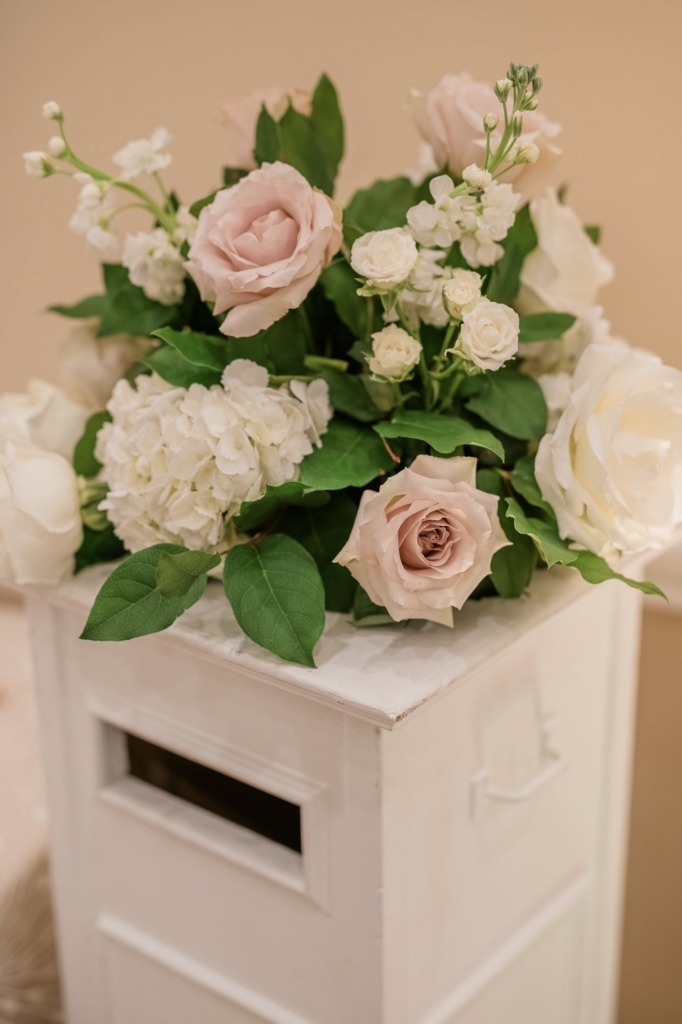
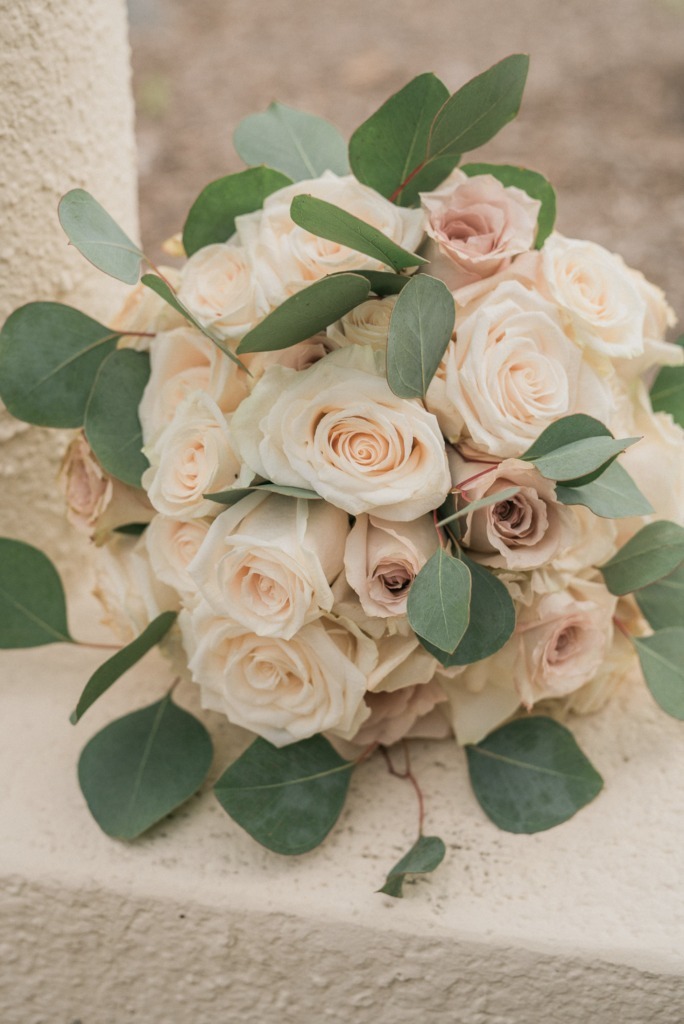
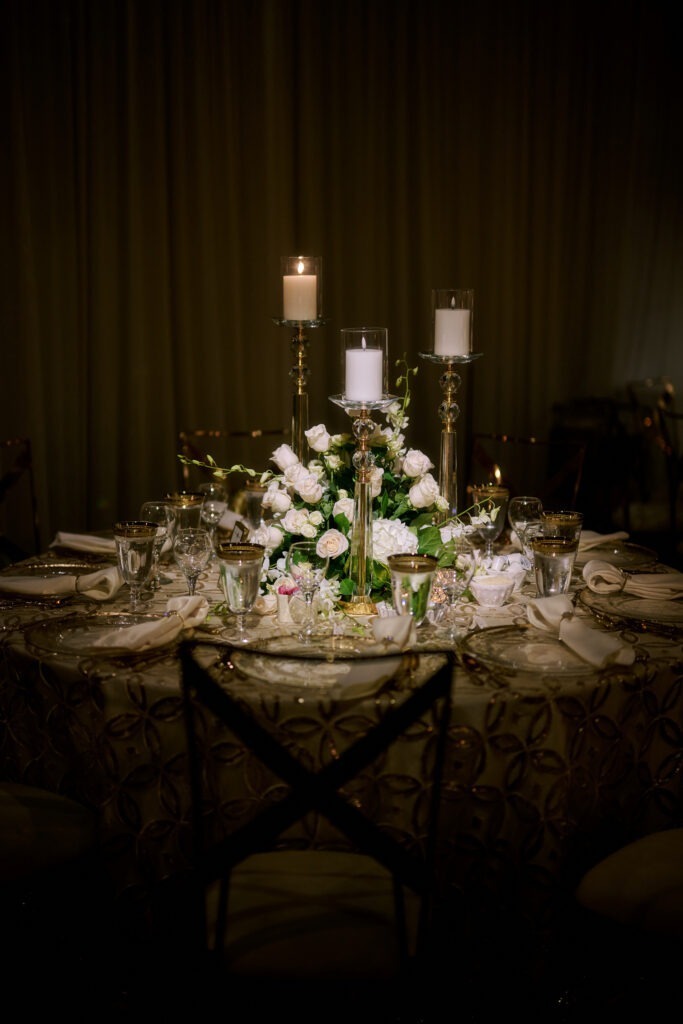
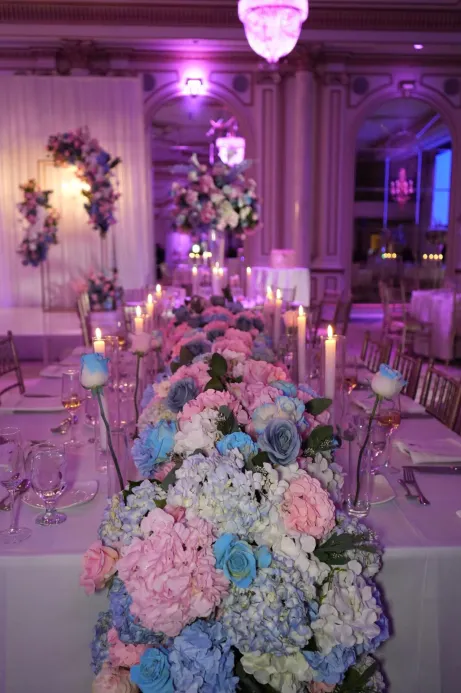
A large installation doesn’t have to stand alone as an isolated showpiece. Some of the most effective reception designs we’ve built integrated the installation with the surrounding table florals so the whole room felt like one connected environment. Overhead garlands that echoed the greenery used in the centerpieces below. A flower wall whose color palette bled into the sweetheart table arrangement in front of it. Hanging pieces that picked up the same bloom varieties found in the bridal bouquet.
That kind of visual continuity is something we plan intentionally during the design phase. It prevents the “wow piece plus boring everything else” problem that happens when too much of the budget goes into one statement element and the rest of the room gets neglected. Balance across the space is what makes the whole reception feel immersive rather than one-note.
Wedding receptions aren’t the only occasion for large-scale floral work. We’ve built installations for marriage proposals on private rooftops in Manhattan, brand launch events in Midtown galleries, milestone birthday dinners at restaurants in the West Village, and holiday parties in corporate lobbies throughout the Financial District.
The design approach shifts depending on the event type and the audience, but the structural rigor stays the same. If you’re planning something beyond a wedding and it involves flowers on a scale bigger than a tabletop arrangement, we should talk.
Frames, grids, and structural bases are built and tested at our Midtown workspace before they arrive at your venue. Nothing is improvised on site.
Hotels, lofts, galleries, rooftops, restaurants, and private residences across Manhattan, Brooklyn, Queens, Long Island City, and Staten Island. We know the rigging specs and load-in logistics at dozens of locations.
Design, sourcing, fabrication, transport, on-site assembly, final styling, and post-event strike. One team, one point of contact, start to finish.
Licensed, insured, and familiar with the liability and damage policies at venues throughout the city. No surprises for you or your venue coordinator.
Call us at (929) 833-8990 or fill out the form below with some details about your venue, your date, and the type of installation you’re imagining. Even a rough idea is enough to start the conversation. We’ll follow up within a day.