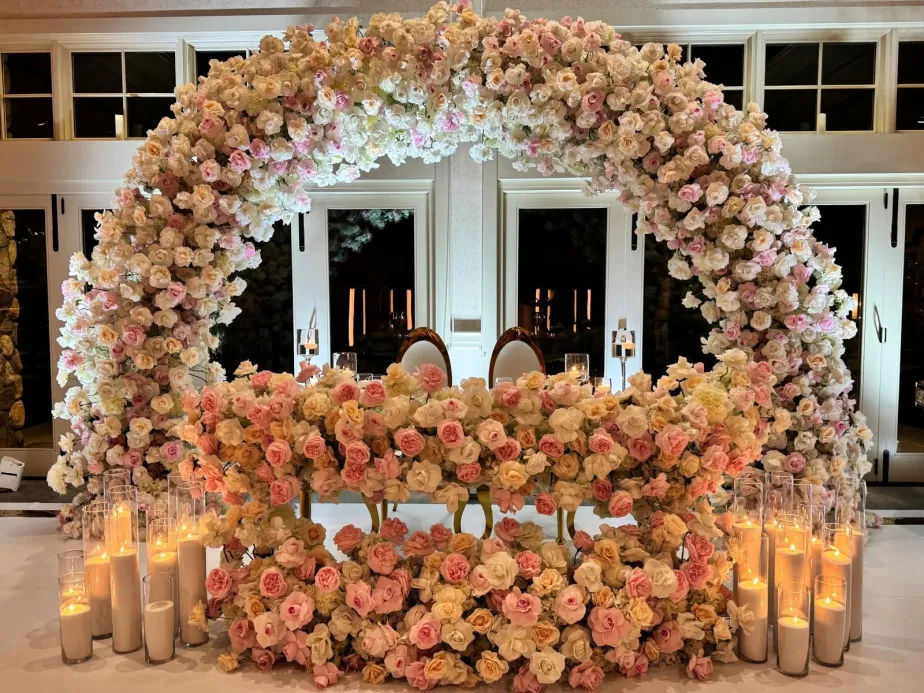
Most ceremonies in this city clock in at around fifteen minutes. Twenty if there are readings. But ask any bride what part of the wedding she replays in her head six months later, and it’s almost never the dance floor or the cake cutting. It’s the walk down the aisle. It’s seeing her partner standing at the altar. It’s that specific moment in that specific room. We’ve spent over a decade making sure the flowers in that room are worthy of what’s happening inside it.
Picking ceremony flowers before understanding the physical space is like buying curtains before measuring the windows. Sounds obvious, but you’d be surprised how many florists skip this step and jump straight into bloom selection during the first meeting.
Our process goes the other direction. Where’s the light hitting at the time of your ceremony? Is there a feature wall behind the altar – exposed brick, stained glass, a big window framing the skyline – that your florals should play off instead of covering up? How far back does the last row of seating sit? Because the couple in row twenty sees a completely different version of your altar arrangement than your mom in the front row does. We’ve learned this stuff the hard way, over years of setting up in churches on the Upper East Side, hotel ballrooms in Midtown, converted warehouses in DUMBO, and park pavilions in Queens. Each space has opinions about what works inside it, and we’ve gotten good at listening.
Here’s a thing nobody tells you during venue tours. Your photographer is going to shoot the ceremony from at least three different positions. Straight down the aisle from behind you. From the side where the bridal party stands. And from somewhere in the guest seating, probably crouched at the end of a row. The altar arrangement has to hold up visually from all three spots.
A single gorgeous urn that looks incredible head-on can completely disappear in a side-angle shot. Two flanking arrangements that read beautifully from the seats might look unbalanced from the photographer’s position behind the couple. We think about this during the design phase because fixing it on wedding day isn’t really an option. You can’t move a 40-pound altar piece between the processional and the ring exchange. So we get the angles right in advance, test them mentally against the floor plan, and sometimes tape off positions in our studio to check proportions before build day.
Your guests turn their heads and watch you walk. Your photographer backpedals down the aisle shooting continuously. The videographer catches it from yet another angle. Everything lining that path – every arrangement, every petal, every candle – becomes part of the frame.
Ground-level clusters at the base of every few chairs give you that garden corridor feeling without tripping hazards. Scattered petals along the runner soften the whole path and add color underfoot. We’ve hung small arrangements from chair backs at St. Patrick’s Old Cathedral and lined outdoor pathways with lanterns buried in low greenery at Brooklyn Botanic Garden. One fall wedding on a rooftop in Tribeca, we did nothing on the aisle at all – just let the skyline and the golden hour light carry the whole scene. Sometimes knowing when to hold back is the better design choice.
Tiny detail. Big visual impact in wide-angle ceremony photos. Those end-of-row accents show up in basically every shot your photographer takes from the back of the room. A droopy ribbon with a sad little rose clipped to a folding chair looks exactly as bad as it sounds.
We do small vessels with fresh-cut stems. Greenery ties with one or two focal blooms wired tight. Petite nosegays secured to the frame so they don’t swing or rotate when someone brushes past. Usually every third or fourth row rather than every seat – enough to create rhythm without running up the tab for something that’s really more about texture than spectacle. The attachment method changes depending on what your venue gives you to work with. Chiavari chairs need a clip approach. Wooden pews get ribbon wraps. Those gold banquet chairs hotels love so much are a pain to work with honestly, but we’ve figured out a system that holds.
Photos only tell part of the story. Standing in the actual room shows us air flow, real light conditions, and sightline problems that don’t show up on a venue’s website gallery.
We check floral placement with your officiant beforehand. Nobody wants a rabbi tripping over an urn during the seven blessings because the florist never asked where he’d be standing.
Hotel ballrooms and event spaces in this city pump dry air through their HVAC systems like it’s a competition. Flowers sitting under a ceiling vent for two hours before the ceremony starts will look noticeably different than they did coming out of our cooler. Petals curl. Greenery dries at the tips. Delicate blooms like sweet peas just give up entirely.
We’ve dealt with this at enough Midtown and Financial District venues to have a playbook. Misting before placement. Strategic positioning away from direct airflow. Choosing hardier varieties for pieces that’ll sit exposed the longest. At one wedding at The Pierre, we discovered during setup that the ballroom’s left side ran about eight degrees warmer than the right because of sun exposure through the windows. Moved the primary altar arrangement eighteen inches to the right and it lasted the full day without a single wilted head. Nobody noticed the shift. That’s the kind of on-the-ground adjustment you can only make if you’ve done this enough times in enough rooms.
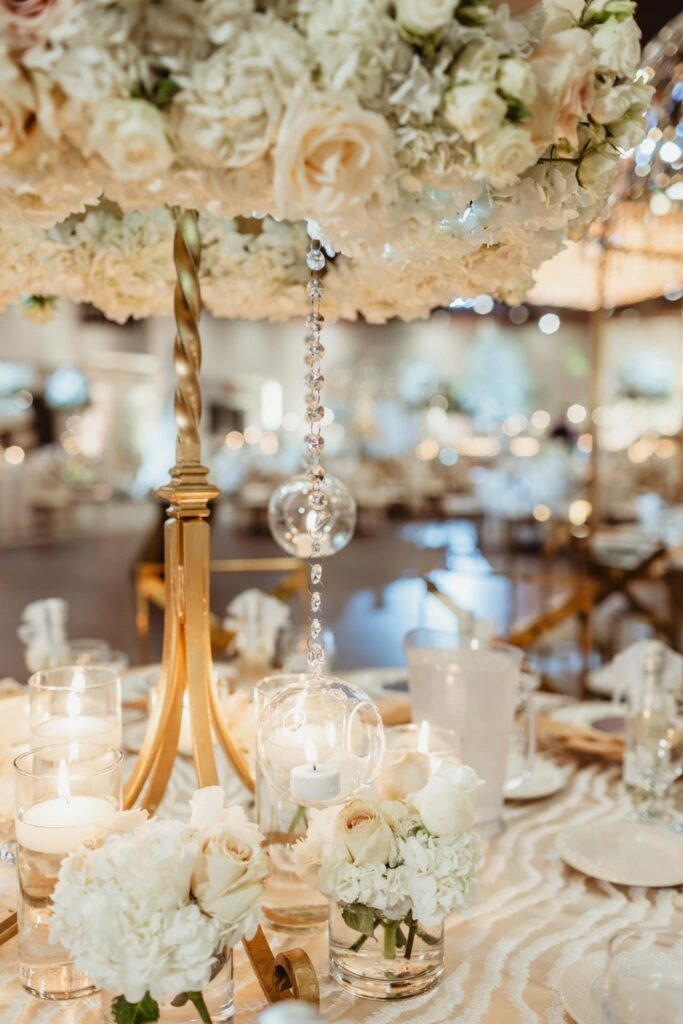
Rooftop in Tribeca in August. Wind came out of nowhere an hour before the ceremony and nearly walked a lightweight arch right off the edge of the terrace. That was years ago and we still talk about it at the studio. Since then, every outdoor structure we build gets weighted bases, sandbag anchoring, or venue-approved tie-downs depending on what the space allows.
Sun is the other issue. Direct afternoon exposure will cook delicate stems faster than most people expect. Garden roses hold up okay. Peonies – depends on the day and their hydration level. Sweet peas, forget it. We pick outdoor ceremony varieties based on proven stamina in real conditions, not based on what looks prettiest in a Pinterest screenshot taken inside an air-conditioned studio somewhere in California. And if your venue requires a rain plan, we design the florals to function in both spots from the start. Building a beautiful ceremony garden for location A and then scrambling to make it work in location B when the forecast shifts is a recipe for a mediocre result in both places.
These get their own dedicated page on our website because the design and fabrication process is involved enough to warrant it. But since the arch or chuppah is usually the single most prominent piece in any ceremony design, a few things belong here.
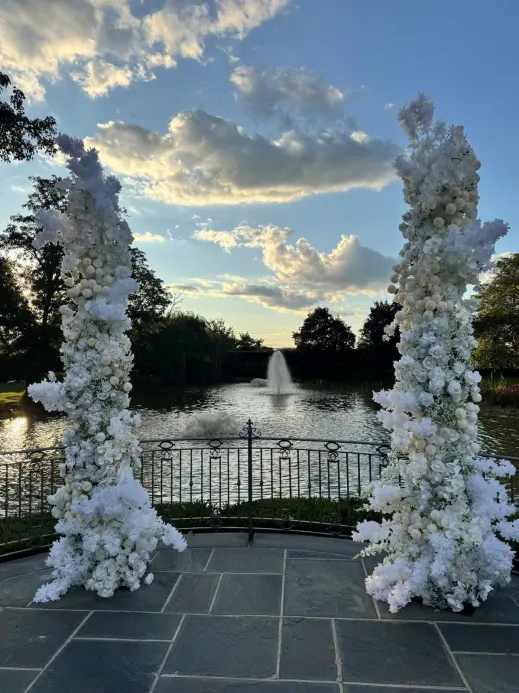
We build custom structures in our studio. Metal, wood, acrylic – depends on your venue and your look. Then we layer the floral work onto the frame on-site, which lets us adjust density and placement based on the actual lighting and backdrop we’re working with that day. Asymmetrical builds where blooms concentrate on one side and thin out gradually across the top are probably our most requested style right now. Full-coverage arches packed with roses still have a big audience. Minimal greenery on a geometric metal frame is popular with couples going for something modern. Whatever direction you lean, this piece gets a disproportionate amount of our attention because it’s the backdrop for the most important photos of your day.
Big ceremony pieces cost real money. Leaving them behind in an empty room while your guests relocate to the reception space is a waste of that investment. So we design with relocation baked in from day one.
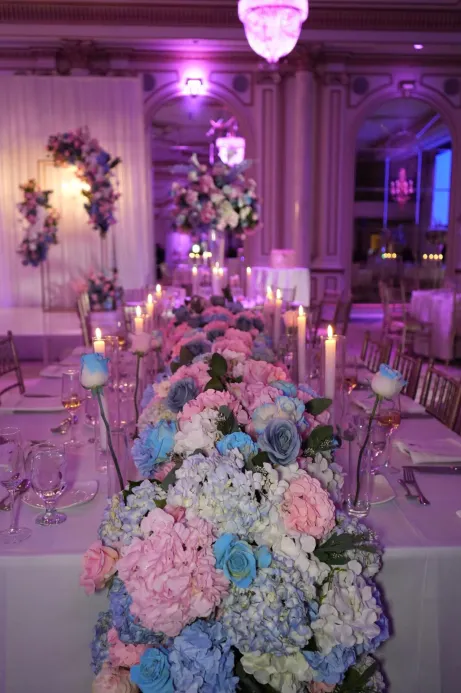
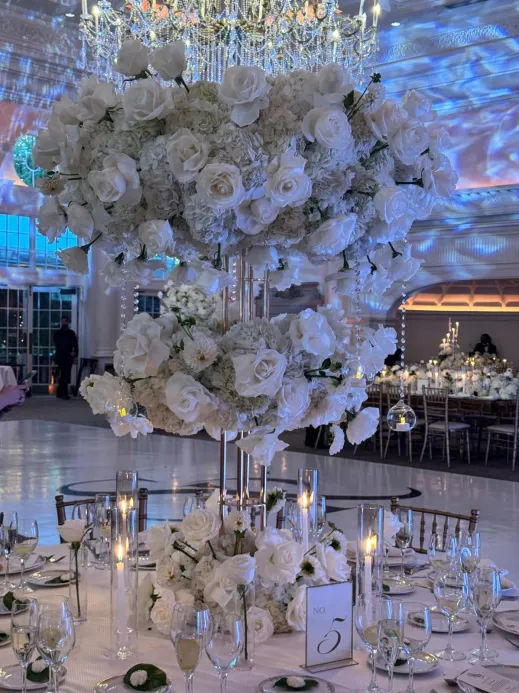
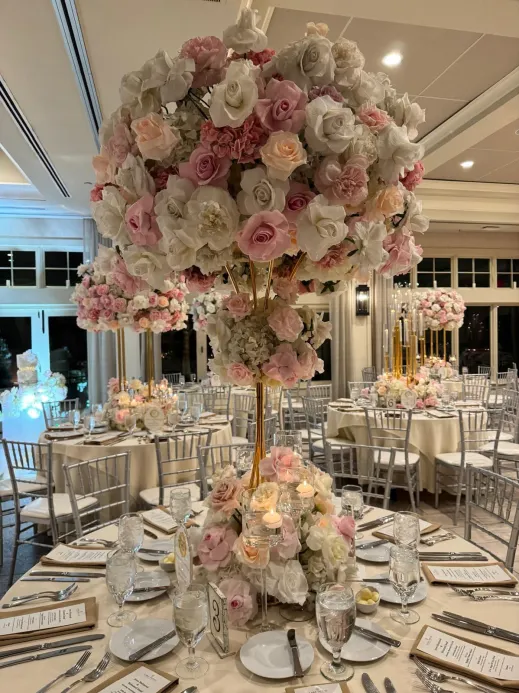
Altar urns get picked up and moved to the bar. Aisle clusters go onto cocktail tables. The arch repositions as a backdrop behind the head table or near the photo booth. Pulling this off smoothly takes planning that happens weeks before the wedding, not a scrambled conversation with the venue coordinator twenty minutes before cocktail hour ends. We map out the transition sequence with your planner during the design phase. Which pieces move first. Who carries what. Where each thing lands in the reception room. By the time your guests walk into dinner, the florals are already placed and nobody saw the shuffle happen.
The lighting designer aims spots and washes based on where focal arrangements sit. If we move an altar urn to the left two days before the wedding and nobody tells the lighting team, the most expensive floral piece in the room goes completely dark during the ceremony. We’ve seen this happen at other weddings. Not ours.
Photography teams want to know the floral layout so they can pre-plan ceremony angles. The officiant needs clear space for movement. Musicians need room near the altar without a cello case shoved behind a flower pedestal. We reach out to these vendors during planning – usually a quick email or a shared document with placement details and dimensions – so everybody walks in on the wedding day already aligned. Sounds like a small thing. Prevents big problems.
Some churches restrict floral attachment to pews or the altar itself. Certain synagogues have specific chuppah requirements. Hindu mandap designs carry color symbolism that matters deeply to families. Interfaith ceremonies sometimes blend traditions from two backgrounds into a single space.
We always ask about this early. If we haven’t encountered a particular tradition before, we research it and check our understanding with the officiant or a family member before proposing anything. A few years ago we designed flowers for a Korean-American wedding that incorporated elements of a paebaek ceremony and a Presbyterian service in the same afternoon. The floral palette and structural elements needed to honor both without feeling disjointed. We spent extra time on that project and it remains one of our proudest. Getting cultural details right isn’t a nice-to-have. For a lot of families, it’s the whole point.
Scope drives cost. Two medium altar arrangements and some petals on the runner is a fundamentally different budget than a full ceremony build with a custom arch, six aisle clusters, pew markers on every row, and a backdrop installation.
We separate ceremony pricing from reception and personal flowers in every proposal. Altar arrangements get their own line. Arch or chuppah work gets its own line. Aisle design, markers, entrance florals – all itemized. That layout lets you see where the dollars go and decide where to invest versus where to pull back. Maybe the venue has gorgeous architecture behind the altar and you’d rather skip the backdrop arrangement and put that money into the aisle. Great, we adjust. Maybe you care more about the arch than anything else and want to keep the rest minimal. Also great. We’ll rework the numbers until the plan matches your priorities.
Our team has set up in churches, synagogues, hotel ballrooms, lofts, rooftops, public parks, and private gardens across Manhattan, Brooklyn, Queens, and Staten Island. Venue-specific knowledge makes the day go smoother.
We don’t rent pre-made arch frames from a party supply company and hope they fit. We fabricate structures at our studio, test them, and transport them in pieces for on-site assembly.
Weighted bases, wind-resistant varieties, UV-tolerant blooms, and designs that work in both the primary outdoor location and the indoor rain plan. We prepare for the weather you want and the weather you might get.
After setup, we do a full check under real lighting conditions and clear everything with your planner before a single guest enters the space.
Call us at (929) 833-8990 or drop your details in the form below. We’ll ask about your venue, your ceremony format, any cultural or religious elements to incorporate, and what you’re picturing for the overall feel. From there we put together a proposal mapped specifically to the space where you’ll be saying your vows.