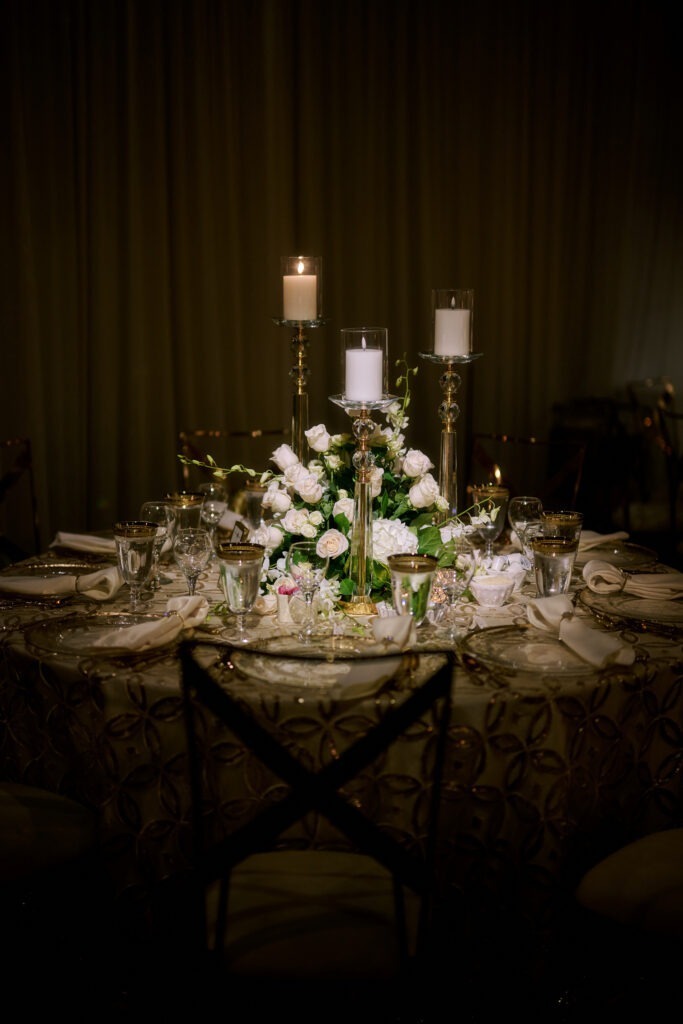
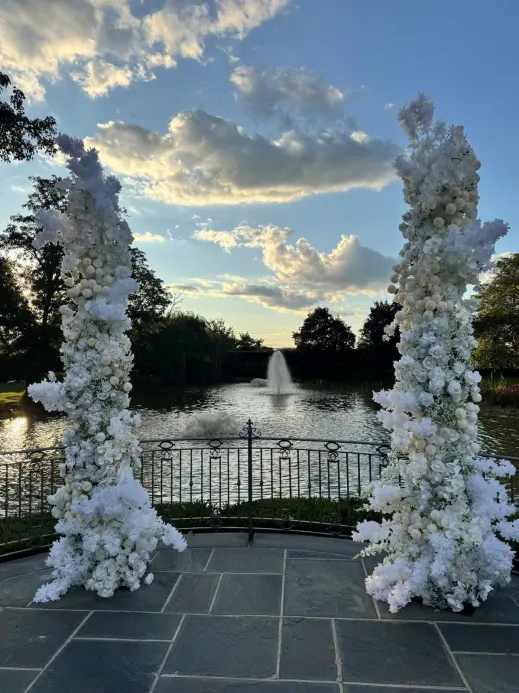
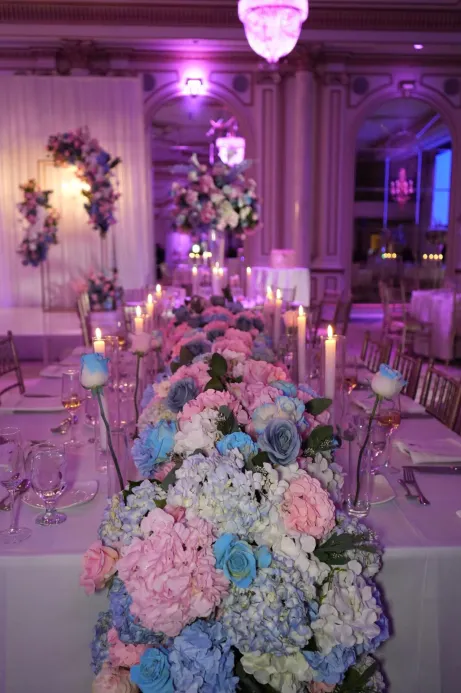
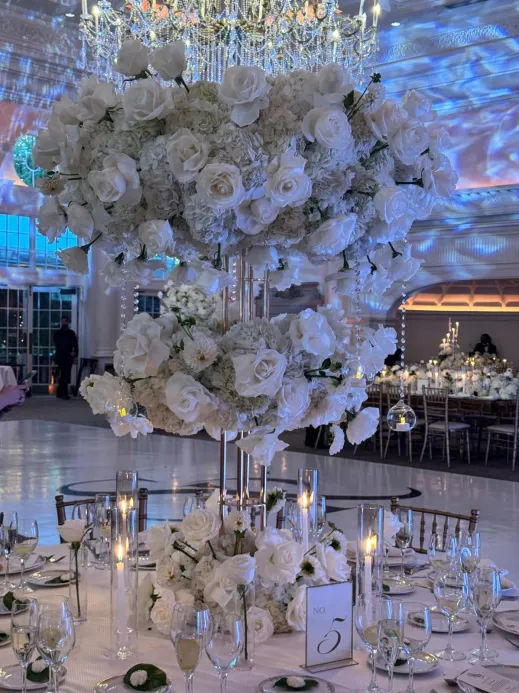
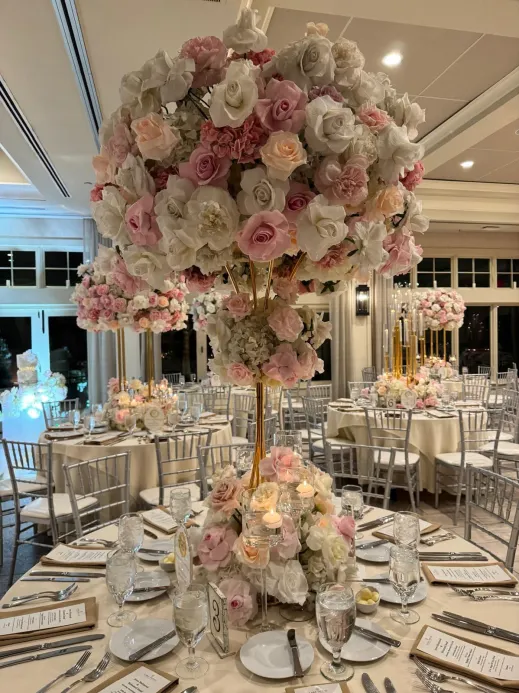
We built our first chuppah for a wedding at Angel Orensanz on the Lower East Side back in 2015. The couple wanted something that felt rooted in tradition but looked nothing like what their parents had. Birch poles wrapped in wild jasmine, an asymmetrical canopy of garden roses and ferns, and a hand-draped tallit their grandmother brought from Israel. That single project taught our studio more about structural floral design than the previous three years combined – and it’s the reason we invested in building a dedicated fabrication workflow for arches, chuppahs, and ceremony structures that we still use today.
Grab any wedding album and flip to the ceremony section. What’s behind the couple in nearly every single frame? The arch. The chuppah. Whatever structural element anchors the space where vows happen. It’s the most persistent visual element of the entire ceremony – more prominent than the altar arrangements, more visible than the aisle design, and the one thing that shows up in the background of candid guest photos too because people take pictures from their seats.
A wobbly rental arch with grocery store garland zip-tied to the crossbar looks exactly that bad in professional photography. The camera doesn’t lie. Harsh truth, but that’s why couples who care about how their wedding photographs come to us for custom builds instead of grabbing something off a party rental catalog.
We don’t rent pre-made arch frames from event supply warehouses. Never have. Every structure that leaves our studio gets fabricated specifically for the couple who ordered it, based on their venue dimensions, their ceremony layout, and the floral density they’re going for.
Metal frames for modern aesthetics. We weld steel or aluminum into rectangular, hexagonal, circular, or completely freeform shapes and finish them in matte black, gold, brass, or raw brushed metal depending on the look. Wooden builds for rustic, organic, or garden-inspired ceremonies. Birch, cedar, reclaimed barn wood – the species depends on the visual tone and the venue context. Acrylic panels for couples who want something that feels airy and contemporary. Lucite catches light in a way that metal and wood can’t, and it lets the floral work appear to float.
Each frame is built to be disassembled for transport, reassembled on site, and sturdy enough to support however much floral weight the design calls for. We load-test everything in the studio before it gets anywhere near your venue.
The bare frame is just the skeleton. What makes it come alive is how we dress it with flowers, greenery, and sometimes non-floral elements. A few approaches we cycle through regularly depending on what couples are asking for:
Asymmetrical garden builds. Blooms concentrated heavily on one upper corner and trailing diagonally down one side, thinning out as they go. Greenery fills the negative space loosely. This style photographs with beautiful movement and feels less rigid than a fully symmetrical design.
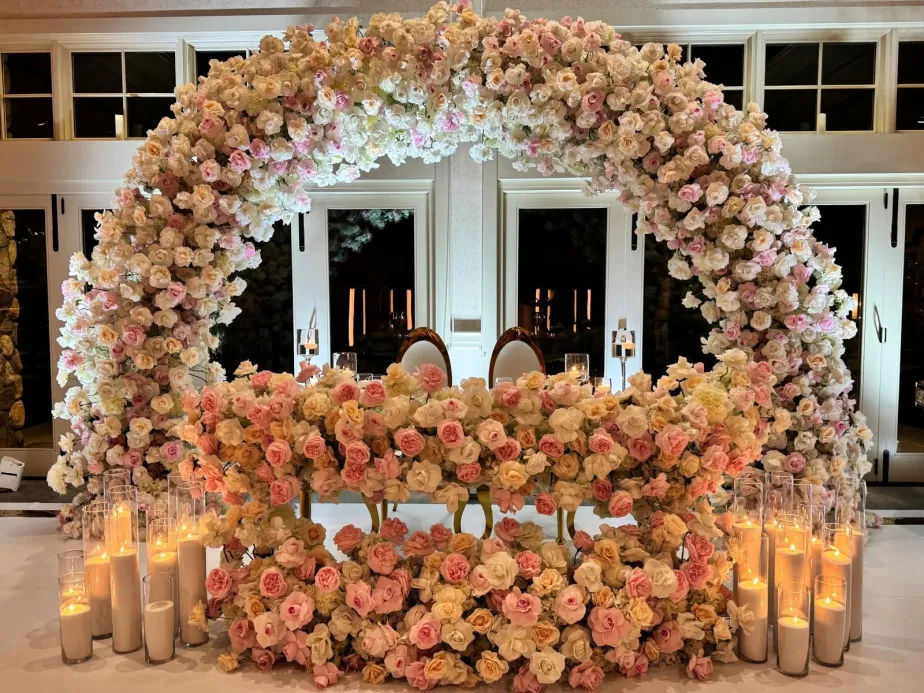
Full-coverage arches. Every inch of the frame wrapped or clustered with flowers. Dense, romantic, overwhelming in the best possible way. These require a lot of stems and a lot of labor but the payoff is a photo backdrop so lush it almost looks unreal.
Greenery-dominant with focal blooms. Mostly foliage – eucalyptus, smilax, Italian ruscus, maybe some ferns – with strategic pops of a single flower type. Roses at the apex. Peonies clustered on one side. Orchids dripping down from the top bar. The greenery does the structural work and the flowers provide the punctuation.
Minimal and architectural. A clean metal frame with very little on it – maybe a single trailing vine, a few dried palm fans, or a sparse arrangement at one corner. Less is genuinely more when the venue already has a strong visual identity. That SoHo loft with the massive arched windows doesn’t need an arch competing with the architecture. It needs something that frames without overpowering.
Every frame is assembled, weighted with floral equivalent mass, and inspected at our studio before transport day. We don’t discover structural problems at your venue.
Ceiling height, floor material, anchoring restrictions, load-in dimensions – all of this factors into the build before we cut a single piece of metal or wood.
A chuppah isn’t decorative. It’s ritually significant. The four poles and overhead canopy symbolize the home the couple will build together, and for many Jewish families, the design of the chuppah carries deep emotional weight. We approach every chuppah project with that understanding front and center.
Some couples want a traditional four-post structure with a fabric canopy and minimal floral adornment. Others want the posts completely wrapped in blooms with a dense floral ceiling overhead. We’ve built chuppahs that incorporated a family heirloom quilt as the canopy. One couple brought hand-embroidered fabric panels from their grandmother’s collection and we engineered the frame to display them as the overhead covering while florals climbed the posts.
Synagogue requirements matter here. Some have specific size guidelines. Others restrict where the chuppah can be positioned relative to the bimah. A few require that the structure be freestanding without any attachment to the building. We ask about these rules during our very first conversation and confirm details with the officiant or synagogue coordinator before we start designing.
Plenty of NYC ceremonies are secular, interfaith, or simply not tied to a specific religious tradition. The arch in these settings functions as a visual anchor rather than a ritual element, which gives couples a lot more creative freedom with shape, material, and scale.
Circular moon gates have been popular in Manhattan for the past few seasons. They photograph with a softness that angular frames don’t, and they work especially well in venues with hard architectural lines because the curve provides contrast. Triangular frames in raw wood create a bohemian feel for outdoor ceremonies at places like Prospect Park or the Brooklyn Grange. Double arches – two structures placed a few feet apart to create a layered depth effect – photograph beautifully when the florist knows how to vary the density between the front and back frame, which we do.
The shape you choose affects the floral layout, the venue footprint, the sightlines for guests, and the photography angles. We walk through all of that during the design process.
A ceremony arch sitting on a marble ballroom floor at The St. Regis behaves very differently than one placed on grass at a Staten Island estate or on a wooden rooftop deck in Long Island City. Surface material dictates our anchoring strategy.
Hard floors get weighted bases – heavy steel plates or sand-filled containers hidden behind fabric or greenery. We never rely on the arch’s own weight to keep it upright because a structure tall enough to frame two people standing underneath it has a high center of gravity that doesn’t take much lateral force to destabilize. Grass allows stakes or ground screws depending on the venue’s landscaping rules. Decking usually means weighted bases again unless the venue permits temporary bolting into specific attachment points.
Wind is the variable that makes anchoring non-negotiable for outdoor setups. A gust that wouldn’t knock over a cocktail table can absolutely topple a seven-foot arch with a full floral sail on it. We’ve dealt with this enough times at rooftop and waterfront venues across NYC to have a reliable system for each surface type.
Our arches and chuppahs are built in sections at our studio and transported in a cargo vehicle to your venue. Metal frames break down into bolted segments. Wooden structures come apart at pre-planned joints. Everything fits through standard doorways and freight elevators – because a lot of Manhattan venues don’t have ground-level load-in access and we’ve learned the hard way that measuring clearances matters.
Floral work happens on site after the frame is assembled and positioned. This gives us the chance to adjust bloom placement under the actual lighting conditions and against the real backdrop. A design that looked balanced in our studio under fluorescent lights might need shifting once it’s standing in front of a stone wall lit by late-afternoon sun coming through stained glass. On-site finishing is where the arrangement goes from good to exactly right.
Assembly time depends on complexity. A simple metal frame with a moderate floral build takes about ninety minutes from unload to final styling. A full-coverage chuppah with fabric draping, heavy floral work on all four posts, and a canopy layer runs three to four hours. We schedule accordingly and coordinate the timeline with your planner and venue contact weeks in advance.
Your ceremony arch or chuppah represents a meaningful investment. Letting it sit abandoned in an empty room after twenty minutes of use wastes that investment entirely. Most couples opt to have the structure relocated to the reception space during cocktail hour.
Common second placements include positioning the arch behind the head table as a backdrop, relocating it near the dance floor as a photo station, or placing it at the reception entrance for a dramatic arrival moment. Chuppahs sometimes move to the cocktail area where guests can view the floral work up close while the reception room gets its final touches.
We plan for the second placement during the design phase. Vessel types, floral attachment methods, and the frame’s footprint all get chosen with both locations in mind. A structure that barely fits in the ceremony alcove won’t work behind a head table with four feet less clearance. We map this out on floor plans months before the wedding and verify measurements at both spots.
We get asked about this a lot. Some florists rent generic arch frames from event supply companies and dress them with flowers. It’s cheaper upfront, absolutely. But rental frames come in standard sizes that may not fit your venue’s proportions. The metal finish might not match your aesthetic. And you’re limited to the shapes the rental company stocks – which in our experience means rectangular, circular, or hexagonal. Not much else.
Custom builds cost more because we’re fabricating from raw materials. But the frame fits your ceremony space precisely. The finish matches your palette. The shape can be anything you can sketch on a napkin. And structurally, a frame built for your specific floral load performs better than a generic rental designed to accommodate the broadest possible range of uses.
Some couples genuinely don’t need a custom build and a dressed rental frame serves them perfectly. We’ll tell you honestly which camp your wedding falls into during the consultation. No upsell for the sake of it.
Arch and chuppah pricing breaks into two components. The structure itself – materials, fabrication, transport, assembly, and strike. And the floral work – bloom sourcing, conditioning, on-site application, and the labor hours for installation.
Both show up as separate line items in your proposal. That way you can see exactly where the money goes and make informed decisions. A couple who wants a dramatic structure but needs to control the budget might opt for a stunning custom frame with a greenery-dominant treatment and just a few high-impact focal blooms. Another couple might choose a simpler frame but go heavy on the floral coverage. We present options at multiple investment levels and help you figure out which balance gives you the strongest result for your specific budget.
We treat chuppahs as ritually significant, not just decorative. Religious and family traditions inform every design decision from the first conversation through final placement.
Narrow hallways, freight elevators, marble floors, grass fields, wooden decks, rooftop wind – we’ve assembled ceremony structures on every surface type at venues across Manhattan, Brooklyn, Queens, Long Island City, and Staten Island.
The same people who fabricate your frame in our studio are the ones assembling it at your venue and dressing it with flowers. Full continuity, no subcontractors.
Post-ceremony strike is built into every arch and chuppah package. Our crew returns on schedule, disassembles the structure, removes all materials, and leaves the space clean.
Call us at (929) 833-8990 or fill out the form below. Tell us about your venue, your ceremony format, and any initial ideas you have about shape, style, or scale. We’ll set up a design conversation and start putting together a proposal tailored to your space and your vision.